




Fruits and berries: A keto guide
 , medical review by Dr. Bret Scher, MD
 Evidence based
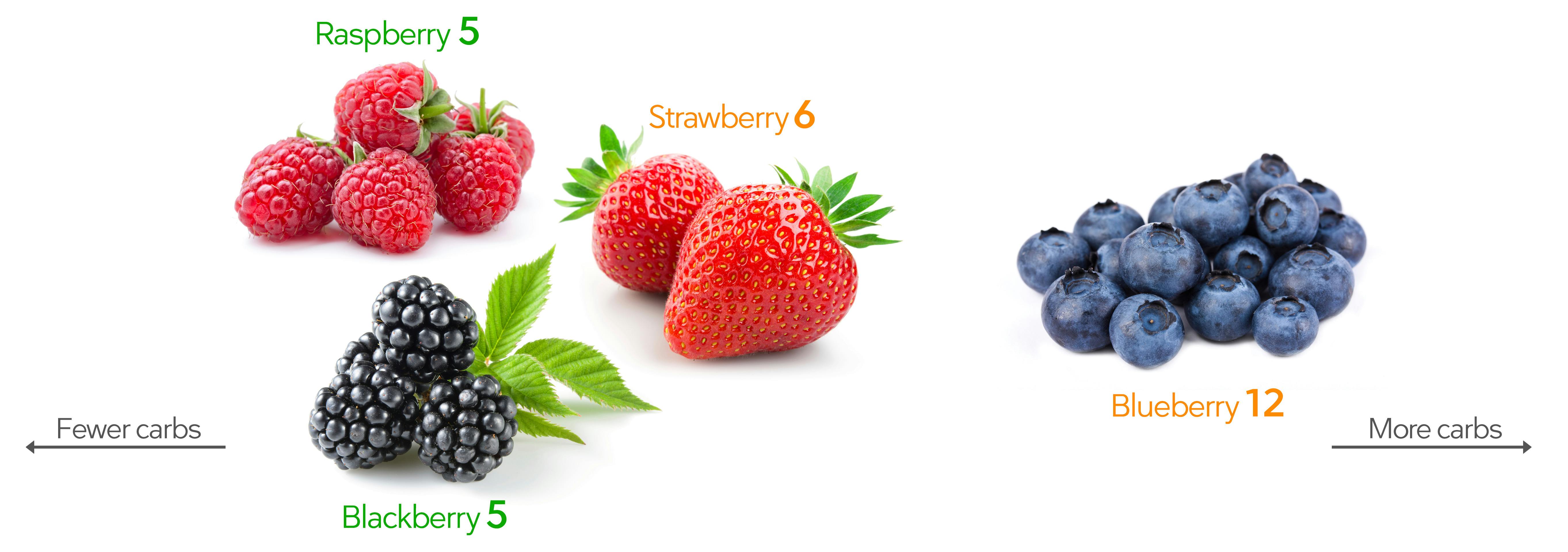
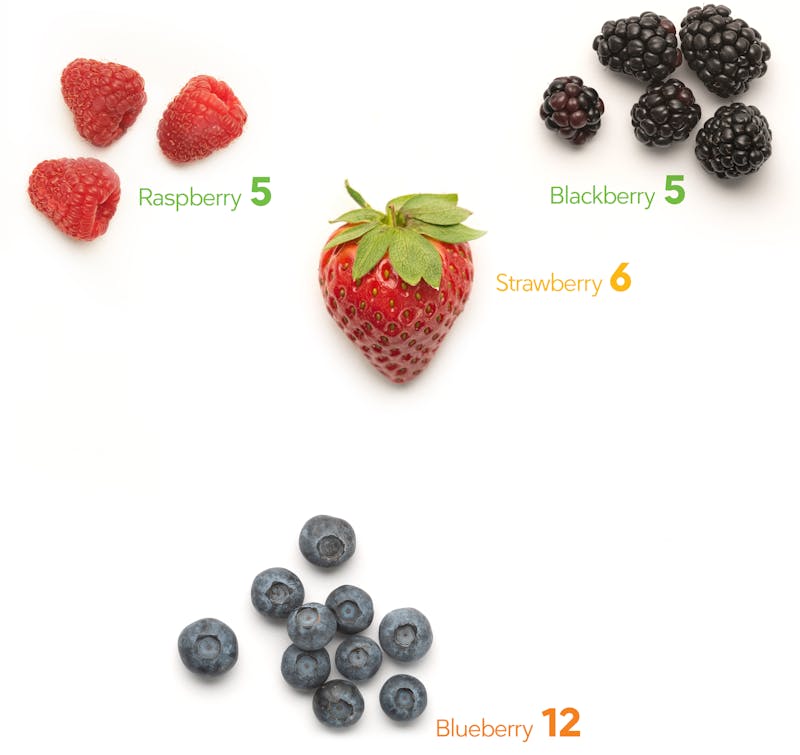
What berries and fruit can you eat on a keto diet? raspberries, blackberries, and strawberries are the best berry choices and can be enjoyed in small amounts. Blueberries contain more carbs, so be careful with the portion.
When it comes to fruit, a few cherries or a small plum may occasionally fit. Sweeter fruits — including bananas, grapes, mangoes, apples, pears, oranges, and pineapples — contain more carbs and are usually difficult to include on a strict keto diet.
A keto diet generally limits net carbs to fewer than 20 grams per day. A single banana or large apple can contain more than an entire day’s carb allowance, so both the type of fruit and the serving size matter.1
Whole fruit is not the same as candy. It contains water, fiber, vitamins, minerals, and other plant compounds in addition to naturally occurring sugar. Research suggests that eating whole fruit does not necessarily worsen blood sugar control.2
However, on keto, the main issue is still the carb content. Fruit and berries contain digestible carbs that count toward your daily total. Think of them as an occasional treat rather than a staple: choose the lowest-carb options, keep portions small, and count the carbs.
If you follow a more flexible low-carb diet, see our low-carb fruits and berries guide for more options.
Keto berries
Below, you can compare the net carb content of common berries and fruits. The options with the fewest carbs are shown first.Key takeaways
Tart is best: Small amounts of strawberries, raspberries, and blackberries are usually fine for a keto diet.View the best berries.
What about Vitamin C?: Does limiting fruit mean limiting nutrition? On keto, you’ll get those important vitamins and minerals elsewhere.
Find out where.
A treat, not a staple: Think of fruit as an occasional treat. Try it with a dollop of unsweetened whipped cream.
See all fruit options.
Below is a visual guide. On the left are the best keto choices.
Berries
Carbs list
Fruits
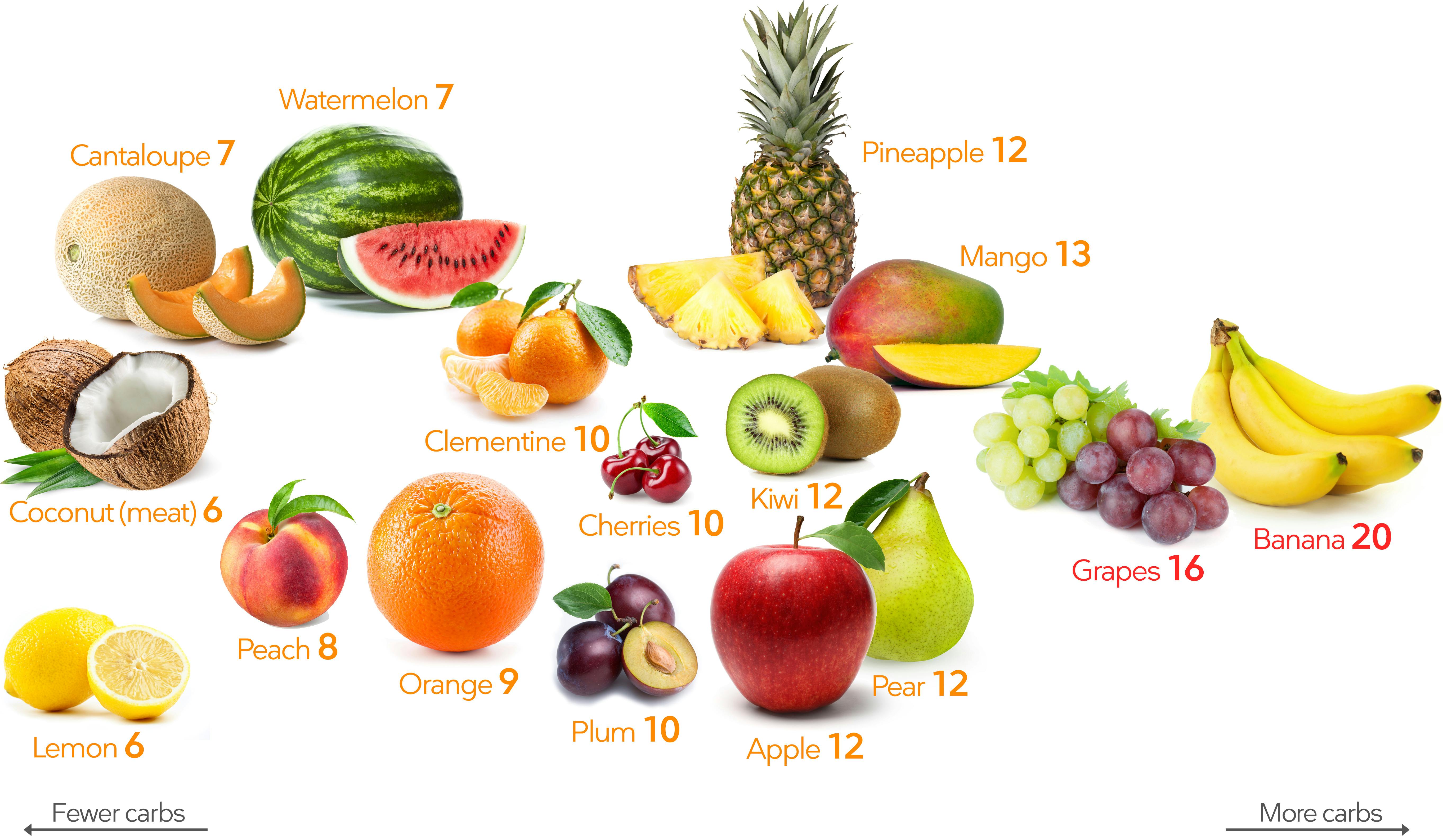
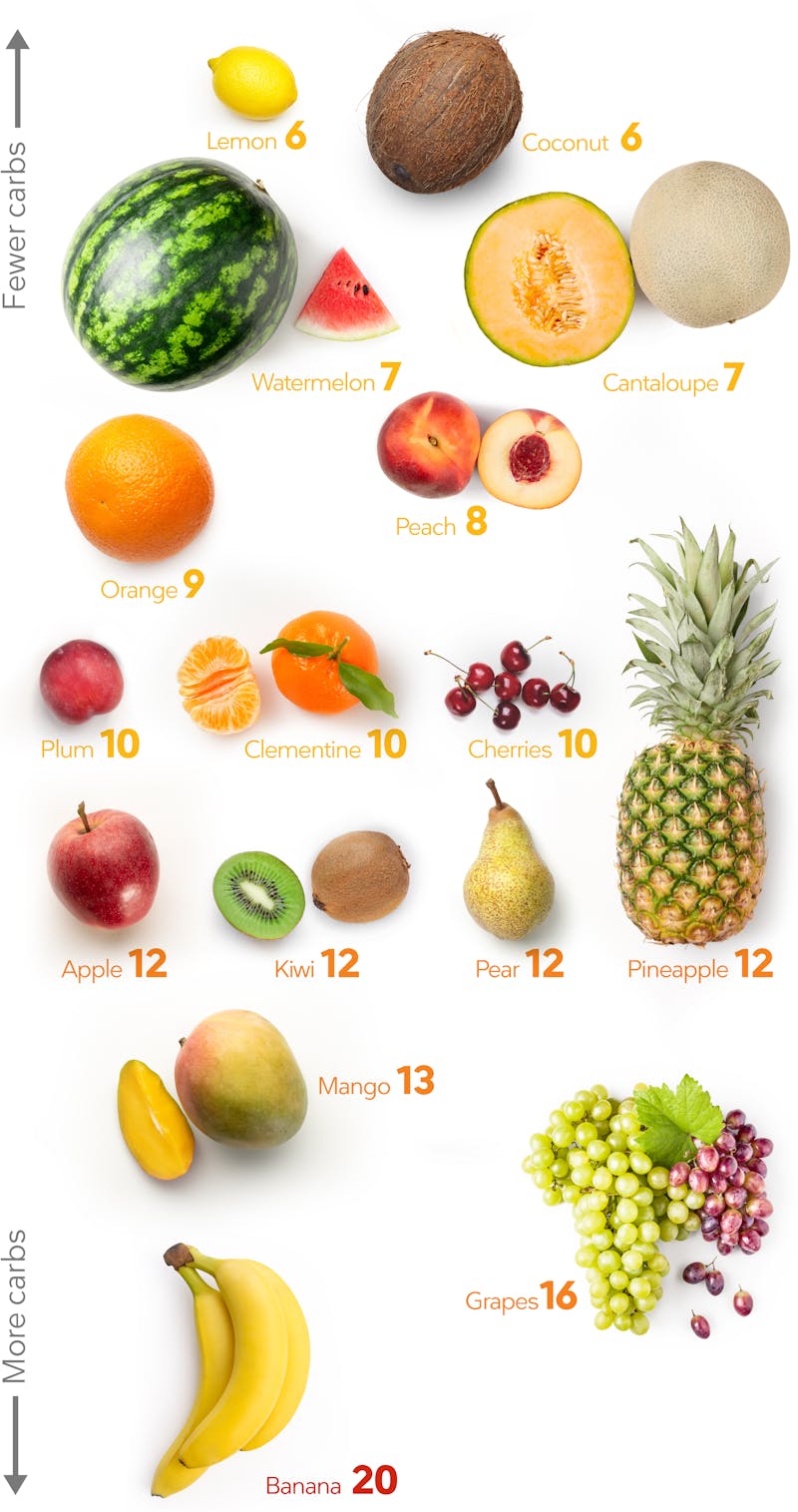
Carbs list
If you eat a large apple (about 25 grams of carbs) or a medium-sized banana (24 grams of carbs), you will have exceeded your daily carb limit on a keto diet.
Fruit = Nature’s candy
On a keto diet you can have some berries every so often and it won’t likely take you out of ketosis. You might even be able to eat a few cherries or a small plum. Be careful, however. And if in doubt, you may want to measure your ketones to learn how fruit affects you.
Don’t we need to eat fruit to get important vitamins and minerals? No, you can get those same nutrients from vegetables.5 In fact, some vegetables, like bell peppers and kale, have more vitamin C than any of the citrus fruits — and a lot less carbs and sugar.6
What fruits can I eat on a ketogenic diet?

From time to time you may be able indulge in a modest amount of fruit as a treat, while still staying in ketosis. Try topping it with a dollop of unsweetened whipped cream.7
Here is a list of the top 10 fruits you can eat on a ketogenic diet, along with the net carbs contained in one serving:
- Raspberries: Half a cup (60 grams) contains 3 grams of carbs.
- Blackberries: Half a cup (70 grams) contains 4 grams of carbs.
- Strawberries: Eight medium-sized (100 grams) contain 6 grams of carbs.
- Plum: One medium-sized (65 grams) contains 7 grams of carbs.
- Kiwi: One medium-sized (70 grams), contains 8 grams of carbs.
- Cherries: Half a cup (75 grams) contains 8 grams of carbs.
- Blueberries: Half a cup (75 grams) contains 9 grams of carbs.
- Clementine: One medium-sized (75 grams) contains 9 grams of carbs.
- Cantaloupe: One cup (160 grams) contains 11 grams of carbs.
- Peach: One medium-sized (150 grams) contains 13 grams of carbs.
Fruit, then and now
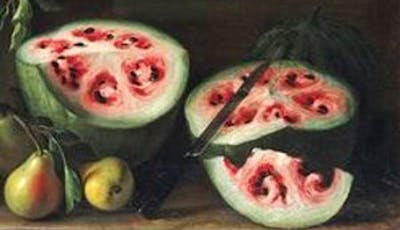
Many people ask: “Isn’t eating fruit very natural from an evolutionary perspective?” That may be true, but modern fruit is different from the fruit of the past. Today’s fruit has been selectively bred to maximize yield, decrease fiber, and increase sweet taste.
What fruits and vegetables looked like before
In addition, for most of human history, fruit would have only been available seasonally. Just like primates in natural environments today, ancient humans could have gorged on fruit when available, using the excess carbs to pack on pounds to survive through lean times.8
In short, in modern times some people might find that their bodies cannot handle the excess carbs and sugar in fruit that’s available 365 days a year.9
Berry recipes
Here are some of our best keto recipes for berries, with the lowest amount of carbs per serving.




Similar keto guides



More


Fruits and berries: A keto guide - the evidence
This guide is written by Dr. Andreas Eenfeldt, MD and was last updated on July 27, 2026. It was medically reviewed by Dr. Bret Scher, MD on November 8, 2021.
The guide contains scientific references. You can find these in the notes throughout the text, and click the links to read the peer-reviewed scientific papers. When appropriate we include a grading of the strength of the evidence, with a link to our policy on this. Our evidence-based guides are updated at least once per year to reflect and reference the latest science on the topic.
All our evidence-based health guides are written or reviewed by medical doctors who are experts on the topic. To stay unbiased we show no ads, sell no physical products, and take no money from the industry. We're fully funded by the people, via an optional membership. Most information at Diet Doctor is free forever.
Read more about our policies and work with evidence-based guides, nutritional controversies, our editorial team, and our medical review board.
Should you find any inaccuracy in this guide, please email andreas@dietdoctor.com.
We define a keto diet as containing fewer than 20 grams of net carbs per day:
Nutrients 2016: Paradoxical effects of fruit on obesity [overview article; ungraded]
Frontiers in Endocrinology 2023: Effect of fruit on glucose control in diabetes mellitus: a meta-analysis of nineteen randomized controlled trials [strong evidence] ↩
Net carbs = total carbs minus fiber ↩
We define a keto diet as having less than 20 grams of carbs per day:
You can check for yourself in the USDA Food Composition Databases that vegetables generally are as rich in vitamins, minerals, fiber, and other beneficial plant compounds as fruits, if not more. ↩
Nutrition facts for oranges, yellow bell peppers, green bell peppers and kale.
↩Although somewhat controversial, current research suggests that we have little reason to fear saturated fat, including the type found in whole-fat dairy:
Open Heart 2016: Evidence from randomised controlled trials does not support current dietary fat guidelines: a systematic review and meta-analysis [strong evidence]
In fact, it seems that people eating higher-fat dairy products tend to have lower body weight, on average, and possibly fewer metabolic issues:
European Journal of Nutrition 2013: The relationship between high-fat dairy consumption and obesity, cardiovascular, and metabolic disease [weak evidence] ↩
For some interesting research about this, see these references:
International Journal of Primatology 1998: Changes in orangutan caloric intake, energy balance, and ketones in response to fluctuating fruit availability [very weak evidence]
Dr. Christopher S. Bard: Why do humans crave sugary foods? Shouldn’t evolution lead us to crave healthy foods? [overview article; ungraded]
Obesity (Silver Spring) 2013: Redefining metabolic syndrome as a fat storage condition based on studies of comparative physiology [overview article; ungraded] ↩
This may primarily apply for people with obesity and type 2 diabetes (insulin resistance), where studies have demonstrated that a low-carb diet can be helpful:
PLOS ONE 2015: Dietary intervention for overweight and obese adults: comparison of low-carbohydrate and low-fat diets. A meta-analysis [strong evidence]
Diabetes Research and Clinical Practice 2018: Effect of dietary carbohydrate restriction on glycemic control in adults with diabetes: A systematic review and meta-analysis [strong evidence] ↩